Justin McLeod founded Hinge, and since leaving the company at the end of last year he’s been teasing Overtone, his AI matchmaking startup. We still don’t know loads about it, but in a recent blog post he made some big promises, chiefly about how he plans to “eliminate” dating app norms.
Elsewhere, Tinder has worked out that its users want to do more of their dating in real life, a nation-first plan to ban sex offenders from dating apps is brewing in South Australia, and there’s a heartwarming appdate from Japan, where Tokyo’s government-run dating app keeps quietly marrying people off.
All this and more in our latest dating app news roundup.
Hinge founder wants to “eliminate” dating app norms
Hinge founder Justin McLeod has said that his forthcoming AI matchmaking service Overtone is “not a dating app”, and that it will “eliminate” the traditional style of dating app profile building.
McLeod, who stepped away from Hinge at the end of 2025, is set to launch Overtone later in 2026 in “select locations”. Solid detail is scarce, with the company’s press release describing “a voice- and audio-forward matchmaking service, enabled by AI and grounded in relationship science, that provides highly curated introductions”.
In the absence of much information about what Overtone will feature, McLeod has offered hints about what it won’t. The traditional dating app structure of “personal ads” and swiping, he suggests, is going out of the window.
McLeod said: “At Hinge, we spent years making each one [traditional dating app step] as thoughtful and painless as possible. What’s different now is that we no longer have to make those steps better. We can eliminate them entirely.”
He added: “Overtone is not a dating app”, by which he means “not a social platform with profiles that reduce people to stats, quotes and photos. There are no opaque, algorithmic feeds trained on split-second impulses. And there’s no juggling likes, matches and chats across many people at once.”
Overtone has also raised $18 million in seed funding, with backers including FirstMark Capital, Pace Capital and, notably, Hinge owner Match Group, which has bought itself a stake in a product pitched as the end of the dating app as we know it.
If that’s enough information to intrigue you, Overtone’s waitlist is now open.
Hinge opens door to friends and family ‘takes’
Hinge, meanwhile, has launched a feature allowing your friends and family to chime in on your dating app life, by adding text, photos, voice notes and videos to your profile.
The function is called Friend’s Take, and it rolled out globally (minus India) in mid-July. The idea is that having the perspectives of loved ones on your profile adds authenticity and clout to your claims of being a brilliant person to date.
To use Friend’s Take you send a link to someone, who then uses it to submit a text, photo, voice note or video to your profile. Each link expires after 72 hours or once 10 people have responded, and you review every submission, choosing up to three to host on your profile at a time.
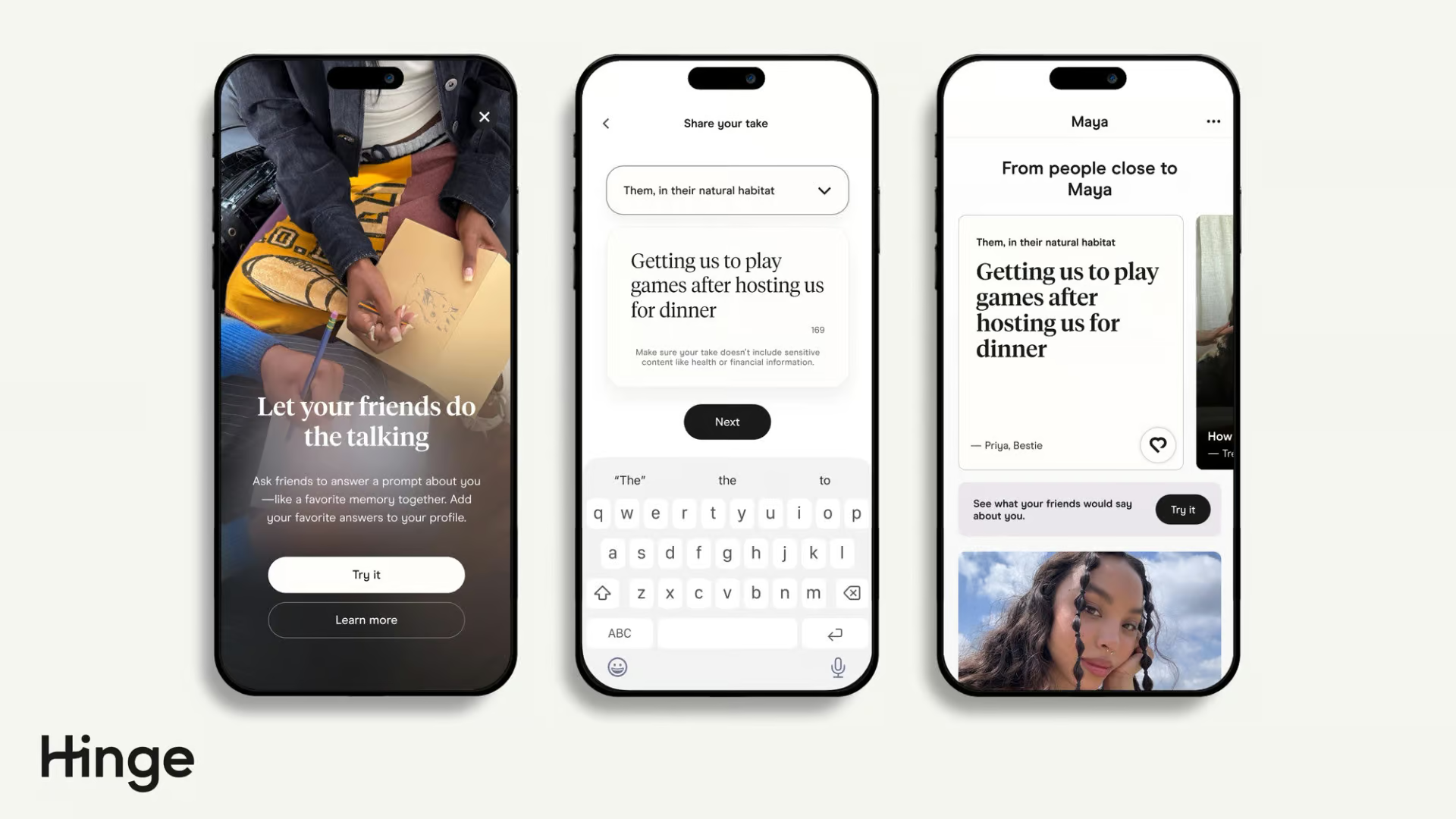
Ben Celebicic, Hinge’s chief product and technology officer, said the new function “makes room for those who are always alongside you as you date and gives potential matches a richer, more authentic sense of who someone is before they meet.”
Happily, if a friend tries to post that photo of you naked and tied to a lamppost at 4am in Amsterdam, you can just reject the image during the review process.
Should sex offenders be banned from dating apps?
Kyam Maher, South Australia’s deputy premier and attorney-general, has proposed a nation-first ban on sex offenders and domestic violence offenders using dating platforms, with prison sentences of up to five years for those breaching it.
Maher is proposing a default 10-year ban from dating platforms for such offenders, with lifetime bans for the most serious cases. The onus would sit on the offender to stay off the apps, rather than on the platforms to identify them.
The proposal remains somewhat speculative for now, but Maher, who announced it while serving as the state’s acting premier, said he was “keen to do this as quickly as possible”, reported SBS News. The model for the law, he added, would be the legislation that makes it an offence for registered child sex offenders to work with children, and it’s being developed in consultation with Match Group and victim-survivor advocates.
Australian authorities have paid closer attention to the potential dangers of dating app use in recent years, with a voluntary industry code introduced in 2024.
The code compels dating apps to cooperate with law enforcement when escalating complaints from users, and to be part of a new safety rating system.
Chatfishing on the rise
Dating app users outsourcing their banter to chatbots, known as chatfishing, is becoming an increasingly widespread issue, and one that’s tougher to clamp down on than the use of AI photos.
Bloomberg reported that Google searches related to chatfishing had risen by 5,000 percent in recent months, while Match Group and the Kinsey Institute’s Singles in America study found that 26 percent of US singles have used AI to enhance their dating lives. (Match Group can hardly complain, having gone big on ChatGPT-era AI itself back in 2024.)
Some dating app users might not view chatfishing as intrinsically unethical. They could see it as simply using AI to hone and improve their texting skills, while still conveying underlying messages that are authentic.
Others see it as deceitful, especially if users don’t disclose that they’re using AI.
AI wingman apps like Rizz, Winggg and YourMove AI generate suggested replies from uploaded screenshots of your conversations. Detection is patchier, although newer tools such as Chatfish try to spot AI-written messages in a screenshot.
Many dating apps have policies against uploading AI-manipulated photos, but don’t ban pasting AI messages into chats. With chatfishing on the rise, how long before they start integrating AI text detection?
Tinder’s big ‘IRL’ date plan
Tinder is ramping up its ‘IRL’ game with the expansion of its Events function, following a successful pilot in Los Angeles.
The function lets you browse local featured events and register your interest in the app, then buy tickets (sold by the event organizers, not Tinder) and potentially match with fellow attendees. Piloted in LA from March, with more than 60 events run so far, the push taps a growing appetite for offline dating among young singles.
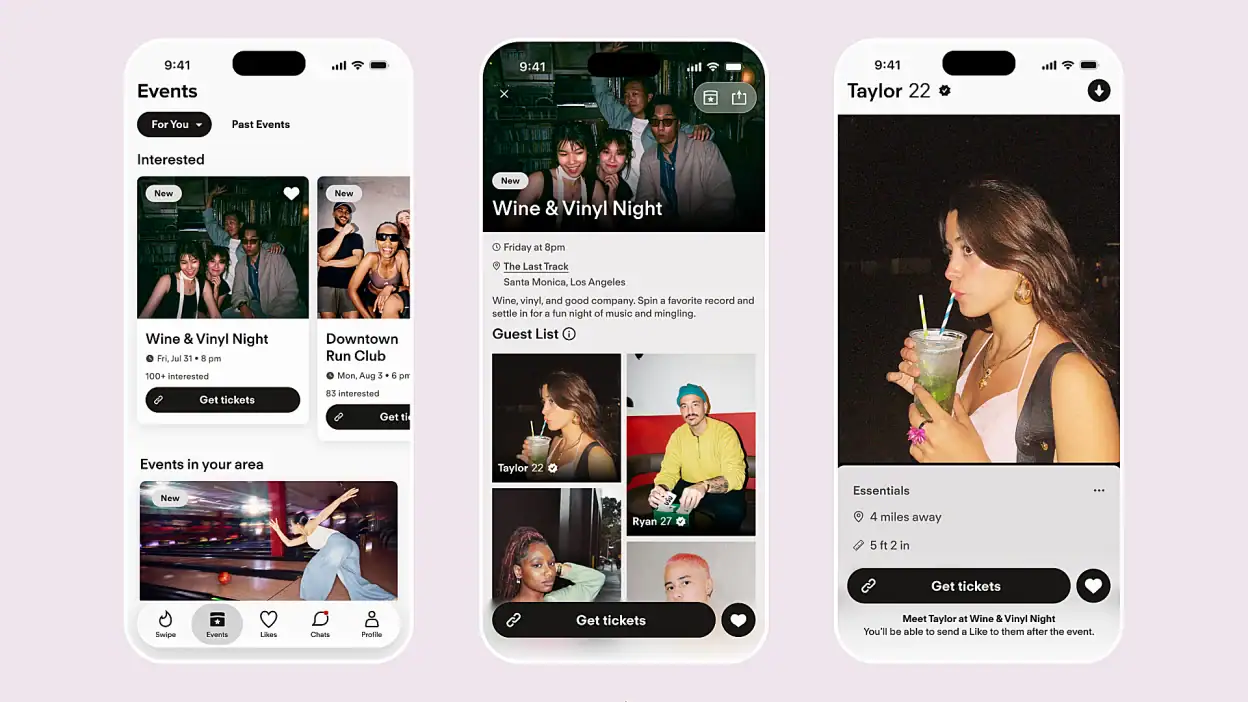
Events is now live in US locations including New York, Dallas, Denver, Kansas City and Phoenix, plus Berlin, Munich, Zurich and Geneva in Europe. Tinder is targeting 26 cities by the end of September, and Match Group CEO Spencer Rascoff told investors the company expects to reach 75 cities by the end of 2026.
There is a stereotypical view of young singles consigning their dating lives to their phones, but Tinder’s own data points to a fervent desire to meet potential dates in the flesh. During the LA test run, 71 percent of eligible users aged 18-24 engaged with Events, ahead of the 63 percent of users aged 25 and older who did the same.
An appdate on Tokyo’s government-run dating app
We end this month’s appdate on a heartwarming note regarding government-induced dating.
In 2024 we noted that the Tokyo metropolitan government was planning a dating app, to promote marriage and potentially help tackle the city’s “chronic” low birth rate.
The AI-powered app, TOKYO Enmusubi, launched in September 2024, and the metropolitan government’s latest figures show that 285 couples who met on the app have married.
TOKYO Enmusubi has around 16,000 registered members, whittled down from roughly 38,000 applications, and on top of the marriages it has produced 803 couples in “serious relationships”.
According to those government stats, then, around one in seven registered TOKYO Enmusubi users is in a marriage or serious relationship thanks to the app.
That’s pretty good going.
