I first learned about Kegels from Oprah. Back in the 2010s, she ran a show about women’s health or something like that, and all I remember is her saying you should squeeze every time you walk through a door, as a good way to sneak in your Kegels.
A Kegel is a squeeze and release of the pelvic floor, the sling of muscles running front to back between your pubic bone and tailbone that holds up your bladder, bowel and uterus. You contract it, hold and let go.
Training those muscles is the recommended first-line treatment for stress incontinence. Cochrane, an international nonprofit that systematically reviews evidence from clinical trials and rates how much you can trust the results, found women who did pelvic floor muscle training were far more likely to report being cured than women who didn’t. It rated that finding “high-quality evidence,” the top level of a four-point scale.
These exercises are also a standard part of postnatal recovery, often encouraged around menopause, and can support core stability and sexual function. The catch is Kegels are an invisible exercise.
Doing it wrong is easy, and nothing tells you that you are. Nothing told me. Door frame, squeeze, carry on is roughly what I’d been doing since my teens, with no form whatsoever and no way to check. That went unchallenged for about two decades, right up until I had the Smile Makers Pelvic Partner in my hands, and then in me.
Smile Makers has been making vibrators since 2013, sold mostly through mainstream beauty retailers rather than sex shops. The Pelvic Partner is the first device it has built that isn’t about pleasure.
It ran on Kickstarter in November 2025 and reached retail in early 2026 at $69 (£59.95). The brand sent me a free unit in exchange for an honest review, with no copy approval and no sight of this piece before it ran.
I’ve owned a few of its vibrators, so I knew what the silicone would feel like. What I didn’t know was what it would feel like to be corrected by one. The premise is almost insultingly simple: you squeeze, it vibrates. You let go, and it stops. The second part was what I turned out to be bad at.
I’ve used it for two weeks, and for most health devices, that would be far too short to draw any useful conclusions. I’d normally opt for a three-month trial. But this one’s different.
Everything the Pelvic Partner sells you happens inside a single rep. It tells you, right now, whether you’re squeezing correctly and whether you’ve fully released. One session tells you what it does. Two weeks will tell you whether it holds.
The design
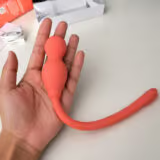
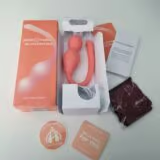
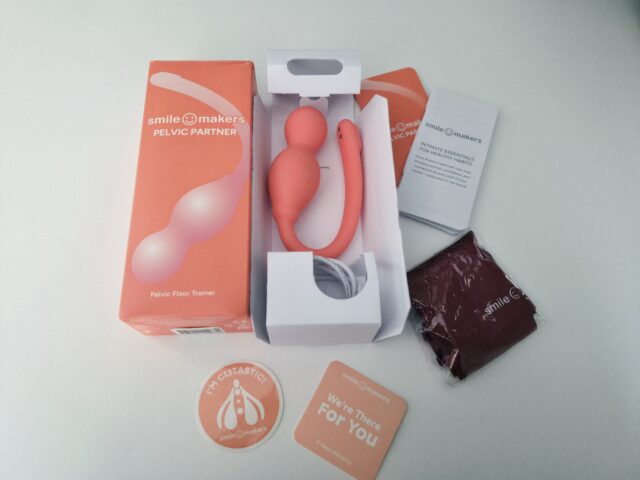
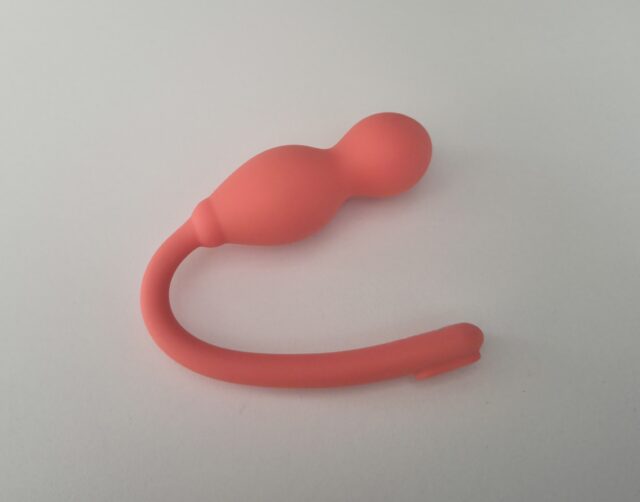
The Pelvic Partner device arrived in a sturdy coral-orange paper box with a satin drawstring bag that I’ve kept using. It looks like something you’d leave out on a shelf, which I suspect is half the point.
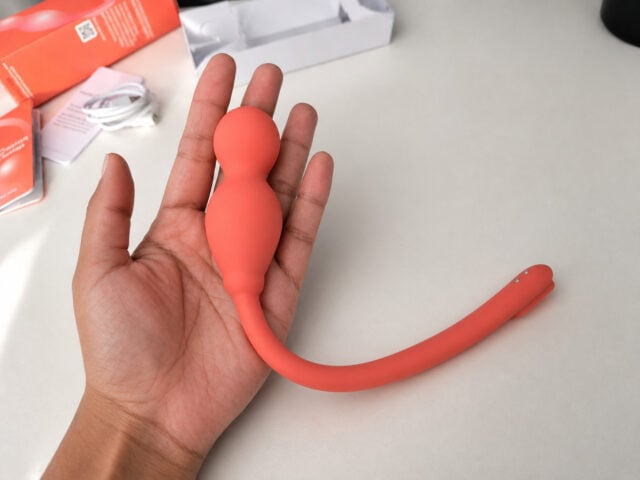
Out of the box, the first thing I did was squeeze it in my hand, and that told me more than the packaging did. It’s cushiony. The silicone gives under your thumb in a way I wasn’t expecting from something with a motor and a battery inside it.
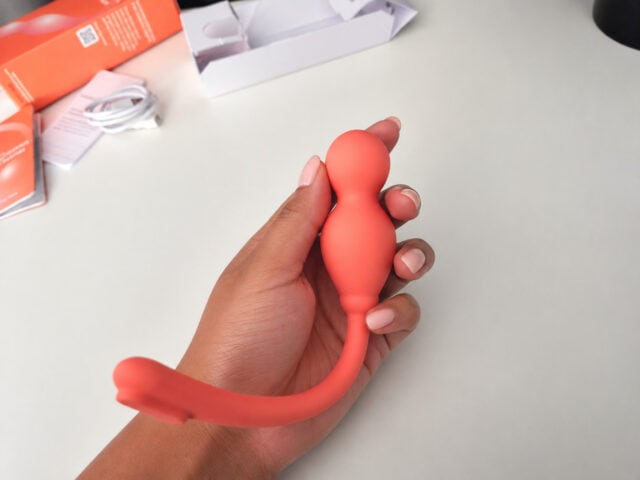
It also warms up fast. Thirty seconds in your palm and it’s near enough body temperature, which matters more than it sounds when you’re about to insert something. The shape is two bulbs on a stem.
Where the insertable part ends, there’s a comfort ring you can feel under your fingers as a stop, so you know your depth by touch. Smile Makers puts the smoothness down to cryogenic polishing.
That’s when you freeze the silicone and blast the surface, which knocks off the thin flashing left by the mold without leaving the residue that a chemical polish would. Basically non-porous, so nothing gets into it.
Most of the 78 grams sit in the head. That’s deliberate, and you feel it. Weight up front means it settles where you put it. The tail is what I’d point to if someone asked what two years of design iterations bought.
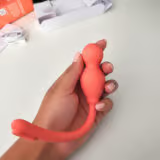
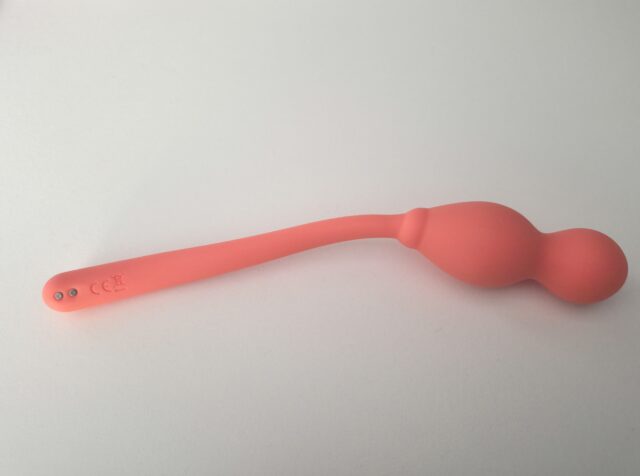
The tail does three jobs at once:
- A handle. Removal is easy, and you’re never fishing for it.
- An anchor. The device doesn’t wander upwards during a long hold.
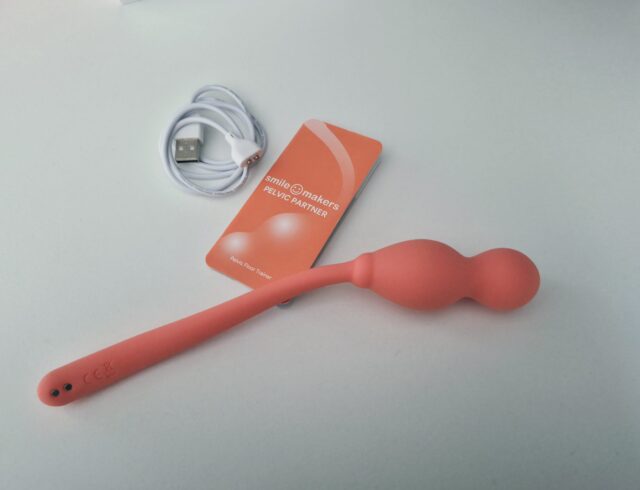
- The control surface. There is exactly one button that sits at the tip of the tail, and it does everything. One press with the device already inserted turns it on. Each press after that steps you up through the eight levels. The light behind it handles status: blinking when the battery’s low, solid while charging, and off when it’s full. The tail folds flat against your skin with the button facing up, so changing level mid-set is a thumb press.
On noise: I could hear the motor in a silent bedroom, and once it was in place, the sound dropped to almost nothing. Nobody in the next room is hearing this.
How it works
The sensing
Most trainers in this price range read pressure from one spot; the Pelvic Partner reads all the way around, a full 360 degrees. At first, that sounds like overkill. Then you use it and realize your pelvic floor muscles have a stronger and a weaker side.
A single-point sensor misses that. If your muscles are stronger on one side than the other, which is super common after childbirth or if you’ve been favoring one hip, a one-spot sensor can sit right where you’re weakest and tell you nothing’s happening, missing the point of using a trainer completely.
Reading all the way around lets you know where to focus and how to train the pelvic floor. The 360-degree sensing also means rotation doesn’t matter. Whichever way the Pelvic Partner sits, the contraction registers. What it can’t do, though, is differentiate a clean squeeze from a squeeze with your glutes.
Like at the top of my range on day nine, I was cheating, using my butt muscles for the squeeze, and the buzz kept going. It reads as force, not technique (but you’re doing yourself a disservice if you stick to doing it this way). It’s on you to notice which muscles you’re engaging.
The feedback loop
There’s a motor in the head. Squeeze past the threshold for whatever level you’re on, and it fires. Hold above it, the buzz keeps going. Drop below, the buzz cuts out. The clever bit is what happens on the way back down.
The buzz doesn’t fade out as you ease off. It stays on until you’ve properly let go, then stops dead. That’s the bit that got me to learn proper control and form.
So every rep hands you two things: the moment you’re squeezing right, and the moment you’ve actually released. Ease off halfway, and the buzz is still there, sitting under you, waiting.
One button, eight thresholds, one motor. I’ve used kitchen timers with more interfaces.
The calibration step
This is buried in Smile Makers’ instructions and deserves much more attention than it gets.
The sequence:
- You insert the device while it’s still switched off.
- You press the button.
- Step two of the guide says it calibrates and vibrates once. That’s Level 1.
So whatever state you’re in when you press that button becomes your zero. Press it while you’re tense, and a half-clenched pelvic floor is now your baseline. Level 1 will feel easy, and you’ll be at Level 3 in a couple of weeks, thinking you’re flying, when really you just started from the wrong place.
I pressed it too intensely on day one. But once I started taking a few slow breaths first, my honest level dropped straight back down. Annoying for about a day. A lot more useful after that.
The levels
Eight of them, grouped by the brand into four bands.
| Level | Band | What it’s for |
|---|---|---|
| 1-2 | Gentle | Getting started, learning what a correct Kegel feels like |
| 3-4 | Building | Strength developing, needs steadier control |
| 5-6 | Strong | Deeper engagement, sustained squeeze |
| 7-8 | Advanced | Most resistance, for consistency more than novelty |
Smile Makers’ advice on picking a level is good. Choose a level where you can finish your reps, move up when it feels comfortable, drop back if you’re straining.
There’s no display, so the device pulses to tell you where you are. Counting is your only readout, and you will lose track. I did, twice in one session.
Writing it in a note on your phone afterward solves it. The levels work as a training dial. There’s no unit attached to them, so level 5 on my device and level 5 on yours are different amounts of force.
Mine moves around too, depending on lube, depth, position and time of day. It’s good for progression, but not much use if you’re planning on handing these numbers to a doctor.
Why there’s no app
Smile Makers leans on privacy in its FAQ, and fair enough, intimate health data on a server is a reasonable thing to be twitchy about.
The more interesting effect of dropping Bluetooth is what it does to the hardware, though. No radio means no antenna in the tail and a smaller board, which is part of how you get over 65 sessions from one charge.
Smile Makers claims 65-plus sessions per charge. I’ve done eight on one charge. That’s not enough to confirm the number, so treat the runtime as untested. There’s also one less thing to go wrong mid-set, which anyone who has had a Bluetooth device drop out at an inconvenient moment will appreciate.
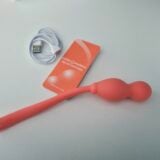
The trade-off is a training tool with no history. Whether that stings depends entirely on what kind of person you are and what information you’re looking for. The charging method is magnetic, which I liked more than I expected.
The cable snaps onto the tail tip, so there’s no port to dry out, and the body stays sealed. That’s also why it survives a shower. They leave the USB plug adapter out of the box. Slightly cheeky, but acceptable in my book.
Two weeks of testing the Smile Makers Pelvic Partner
Smile Makers wants three sessions a week, two to three sets of 10-15 reps, around five minutes a session. Squeeze, hold for three to five seconds, relax for three seconds, repeat. I managed eight sessions in 14 days.
| What happened | |
|---|---|
| Day 1 | Calibrated tense, sailed through level 1, felt pleased with myself, wrongly. Two sets of 10 before I lost count of the pulses and had to guess where I was. |
| Day 2 | Recalibrated properly after exhaling. Back down a level. Discovered my release is a mess. I was letting go at about 70% and starting the next rep from a clench, and the buzz sat there through it all. |
| Day 4 | First session where the reps felt clean. The buzz cut off crisply when I let go. Also, the first time I used enough lube, which is probably not a coincidence: day 2 had a drag on insertion I’d wrongly filed under “normal.” |
| Day 7 | Same level, more control, thinking about it less. Wrote the level in my phone notes afterward, which I should have been doing since day 1. |
| Day 9 | Moved up a level to see what happened. Got six clean reps, then my form went: breath held, glutes in and the buzz still firing. I could feel I’d stopped isolating and dropped back down for the second set. |
| Day 10 | Tried it in the shower to test the waterproofing. It’s fine, and the magnetic charging point stayed sealed, but standing changes the whole exercise, and I couldn’t hold a level I’d been comfortable with lying down. Useful as a reality check on what the numbers mean. |
| Day 13 | Two days off, deliberately. First four reps, the release was sloppy again, and the buzz hung on past where I thought I’d let go. It tightened up within a set, so I don’t know whether that’s real regression or just a cold start. Either way, the device flagged it before I noticed. |
| Day 14 | Landed back on the level I’d been at since day 4, with the release consistent enough that the buzz stops when I expect it to, rather than telling me something new. Still on the first charge, no low-battery light. |
A few practical things I picked up on use
- Lie down. The brand says to keep knees bent and feet hip-width apart, and that’s where the sensor works best. I tried it sitting at my desk, because that’s where I’d realistically do it and spend most of my day. But the abdominal pressure muddied everything. You end up bearing down to trigger the buzz, which is the opposite of the point.
- Use more lube than you think. The head is 1.3 inches across, which fits fine. You would think that, being as smooth as it is, it would slide right in, but if you have more dry days than most, you will find that the silicone drags on the skin, so it’s best to lube up. Water-based only. Silicone lube degrades silicone and will wreck the surface over time.
- Cleaning is easy. Twenty seconds under a lukewarm tap and you’re done. You can use a silicone-friendly toy cleaner if you’re feeling finicky.
- The vibration is strong. Stronger than a feedback signal needs to be. There were moments when the buzz became the point rather than the cue, a very Smile Makers problem to have.
What I can’t tell you after 14 days is whether it improves bladder control. The pee sensation after a hard laugh has stopped, but I’ve never actually had a slip. I’m 34, and that sensation only turned up this year.
Pelvic floor training has decent evidence supporting its use for stress incontinence and postnatal recovery. But that evidence applies to Kegel exercises generally, not to this device in particular.
It does help you do Kegels properly, though, which is no small thing if you’ve spent a decade doing them wrong. I had no baseline assessment or physio measurement, so I can’t tell you whether my pelvic floor is actually stronger.
What I’d change
- Give me a softer feedback mode. At full strength, the buzz distracts from the lesson.
- Show me the level. The button light is already there for battery status, and flashing it once per level at startup would end the counting.
- Make a slimmer one. One size has to cover a range of conditions, including dryness, atrophy, scar tissue and pain.
- Write a proper release program. The sensor already detects it. The guidance stops at technique tips, which leaves the cleverest thing this device does half-used.
- Include the plug. A magnetic cable with no adapter is half a charger.
- Flag the cheat. When I recruited my glutes and held my breath at the top of my range, the device buzzed on regardless. Its sensor can’t fix that, but a note in the guidance would help.
Verdict
For me, two weeks was enough to judge what this device is for. It told me something about my own body that I’d got wrong for several years, and it did that in the first two sessions. The 360-degree sensing does real work.
The tail is smart. Magnetic charging, a two-year warranty from Smile Makers and a claimed 65 sessions per charge are the sort of details that usually get cut at this price. The focus on full release is the story, though. Being told, in the moment, that you haven’t let go yet is worth more to me than any graph.
It loses a point for having no measurement whatsoever, one size only and a buzz louder than the message it carries.