A new era for Bumble is on the way, with the almost-OG dating app agreeing a $1.3 billion sale while still going full-steam ahead with new functions. Will the sale help the yellow app turn around its fortunes after what many see as a slow slide into app irrelevance?
Elsewhere there’s a new gay cruising map service in town, Hinge is lecturin… sorry, we mean ‘educating’ potentially deviant users, and a new report puts numbers to the scale of dating app scamming.
All this and more in our latest monthly dating app news roundup.
Bumble is being sold…
Tech investment company Ithaca Holdings has agreed to buy Bumble for $1.3 billion, with the firm saying that buying the loss-making dating app is a “bet on the future of humanity”.
The all-cash deal values Bumble at $6.05 a share and takes the company private once it closes. Bumble floated in 2021 at a valuation of around $14 billion.
Bumble has struggled in recent years, with the company saying in 2025 that it would cut 30 percent of its global workforce. The deal follows years of declining subscriber numbers.
This could largely be because much of Bumble’s original Millennial user base has left the dating pool. Recently Bumble launched various AI features, such as AI assistance for profile-building, and moved further away from the ‘women message first’ function it built its reputation on at launch in 2014.
Ithaca Holdings said it was operating “in a world transformed by AI”. The company added: “Technology should work in service of our deepest source of fulfillment, human connection and this investment is a bet on the future of humanity.”
Announcing the acquisition, Bumble said it “will continue to be driven by the same purpose that inspired us from the beginning.” Presumably not meaning the ‘women-first’ ethos.
…And launched Handles
Bumble selling up hasn’t slowed down its rollout of new functions. The latest is designed to replace the age-old act of asking for someone’s phone number.
According to a new note from Bumble CEO Whitney Wolfe Herd, if you become aware of someone ‘in real life’ who tickles your fancy (say, a friend of a friend), “asking for a phone number can feel too personal”. Bumble’s new solution is to make this person aware of your Bumble handle.
The new Bumble Handles function can be used by verified users in the US who are on iOS. It generates a handle (aka username) that you can then tell someone about, or have a friend tell them. The recipient types the handle into Bumble and can then ask to connect.
It’s basically an invitation to connect, designed to be the new ‘Can I have your number?’. But is it really “too personal” to ask for someone’s number, or indeed to offer your number to them, in the modern dating world?
Wolfe Herd said: “We’re building a bridge between real-life attraction and digital introductions, making Bumble a place to find someone you’re already curious about.”
Squirt launches gay cruising map
Gay cruising platforms Squirt.org and SQ Dating have launched a map function that highlights popular cruising spots.
Places Map shows where other members have checked in for cruising. Think Google Maps, but for finding men to have sex with instead of restaurants and bars.

Places Map is designed to replace searching for location information on individual Squirt listings. You can filter by type of spot, from bars, clubs and saunas to beaches, parks and gyms, and ‘check in’ to a Place so other users know you’re around, with each check-in staying visible for one hour.
You can also check into a location ahead of time, to let users know that you’re on your way and will soon be ready to roll.
Hinge’s message education class
Hinge is attempting to ‘educate’ users whose app chat is in danger of crossing a line, by launching a new communication tutorial function.
Now when someone sends a message in the app that could breach Hinge’s Community Guidelines, an unwanted sexual comment being the obvious example, it will be assessed by a human moderator. If the moderator decides the message is a serious violation, the sender could have their account removed. If they deem it a minor violation, the sender gets a warning in the app and has to complete an “educational walkthrough” before they can continue using the app.
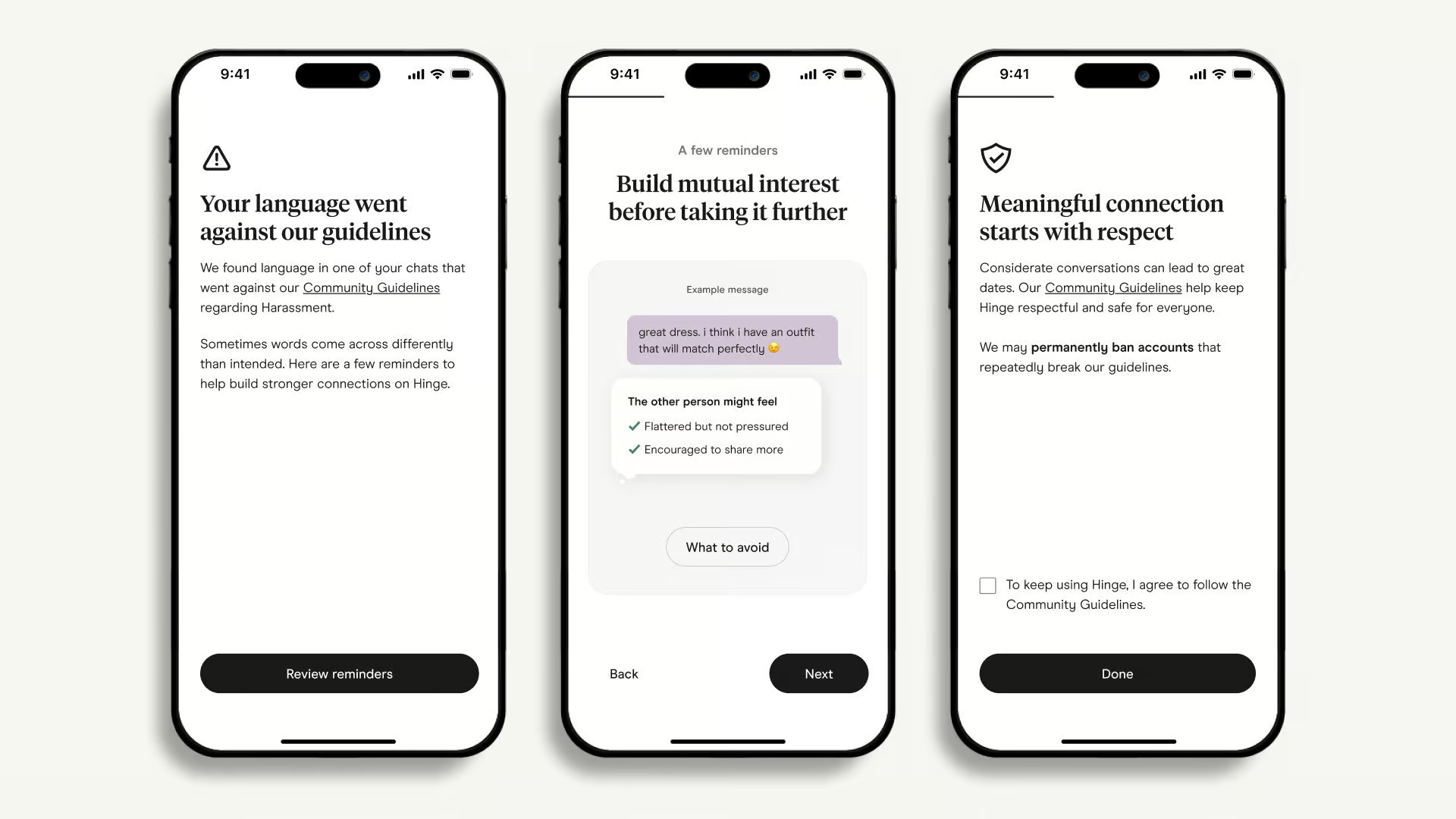
It’s the sexting equivalent of a speed awareness course.
The short educational course shows examples of what Hinge considers harmful behavior. Hinge said: “For example, a dater might be reminded to build mutual interest before making a conversation sexual, keep humor playful rather than personal, and avoid unsolicited comments about someone’s body.”
The move arguably marks a more tolerant attitude to profile and messaging moderation. Hinge has already changed its policy recently to remove sections of profiles that violate terms instead of entire profiles. It also keeps a paying subscriber in the app, where a ban loses one.
Hinge said: “We believe in giving well-intentioned daters a chance to reflect and change their behavior, but accountability remains essential to creating a safe dating experience on Hinge.”
Scale of the app scamming
A new investigation into dating app romance scams has given a glimpse of how widespread the problem has been recently, including the share of scam accounts that manage to get contact details from other users.
Democratic senator Maggie Hassan released a report called Outmatched: Tinder, Scammers, and Match Group’s Efforts to Catch Up. Match Group data provided to the Joint Economic Committee showed that almost 1.5 million Tinder and Hinge accounts belonged to scammers or other bad actors in the first nine months of 2025.
Of those 1.5 million accounts, nearly 500,000 managed to exchange contact information with other Tinder and Hinge users.
The report also found that as of the second half of 2025, most of Tinder’s AI scam detector models hadn’t been updated in years.
Tinder and Hinge have said that they’ve made big moves to stop scammers since then, and that they banned tens of millions of inauthentic accounts across the two apps in 2025.
Since December 2025 Tinder has required new US users to verify themselves with a video selfie, and Match Group reported that this cut interactions with scammers, bots and other bad actors by 70 percent.
So, that’s alright then, isn’t it.
AI ‘sales pitches’ hit dating apps
A dating app whose AI voice agent calls you up (kind of) to talk through date recommendations has launched in India.
Wavelength was developed in Bengaluru. The app’s AI conducts a voice interview with you on signup, asking you questions about yourself and what you’re after from a date. The AI then talks to you about potential matches, ‘selling’ them to you. If both parties decide to go in for a match, they can connect and chat to each other instead of the AI.
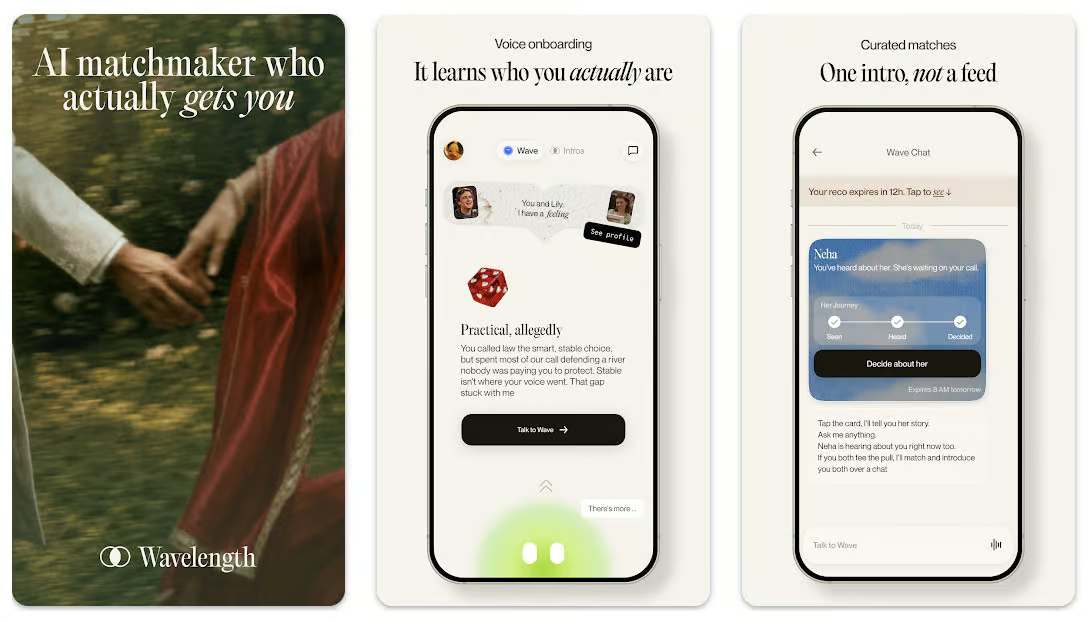
It’s a fairly simple concept, and relying on the AI’s voice call recommendations does away with rampant profile swiping. Profile photos are presented to you later in the app process than the voice recommendation, encouraging you to weigh the AI’s assessment of a person’s personality before you get to see whether they’re hot.
Wavelength co-founder Ishaan Gupta told The Print: “We realised that persuasion is a critical insight in this space, and persuasion at scale can be done by AI.”
Gupta added: “India is a more audio-first country. People don’t necessarily know how to text, but they know how to talk.”
