
Is height important in dating? Is there really any meaningful difference between a hobbit and a basketball forward? Tinder make a joke of this question one April Fool’s, but another dating app has now gone all in on verified heights on profiles.
Elsewhere, new research has suggested that an AI fake dating app could potentially help incels sort out their manosphere obsessions, Bumble 2.0 is imminent (and very AI-heavy), and OKCupid has had its knuckles rapped over a privacy violation.
All this and more in this month’s dating app roundup.
Height verification is no joke
In 2019, Tinder’s April Fool’s joke was an announcement that the app was introducing height verification. As the joke went, users would have to submit a photo of themselves standing next to a commercial building to have their height confirmed and listed on their profile.
Now corporate japery has become reality via another dating app, Tenr, which has announced real height verification.
Adam Moelis, Tenr’s founder, told Mashable: “People care about height, and the app is all about not BS-ing and giving information up front. No other dating app is doing that because it’s a little bit controversial, but we think it matters to people.”
To verify your height on Tenr, you need to get someone to point an iPhone at you and use the device’s LiDAR scanner, which assesses your height to an accurate degree.
Tenr uses AI to matchmake, and sets matched users up on ten-minute video dates. It launched in 2025 and has 7,000 signups so far. Moelis says over 700 users have verified their height since the feature launched a few weeks ago. A roughly 10% take-up for an optional biometric step is nothing to be sniffed at though.
But is verifying your height on a dating app really that controversial? For some dating apps may be about the search for true connection and compatibility, but it’s hard to see height preference as less superficial than judging someone by a picture of their face: pretty standard for most dating app functionality.
Tenr isn’t quite the tape measure trailblazer it may initially seem, though. Hinge allows you to set height preferences for matches, and Tinder tested a paid height preference filter but hasn’t rolled it out.
As Moelis said: “We thought it would be kind of a fun feature”.
Fake AI dating app brings real benefits
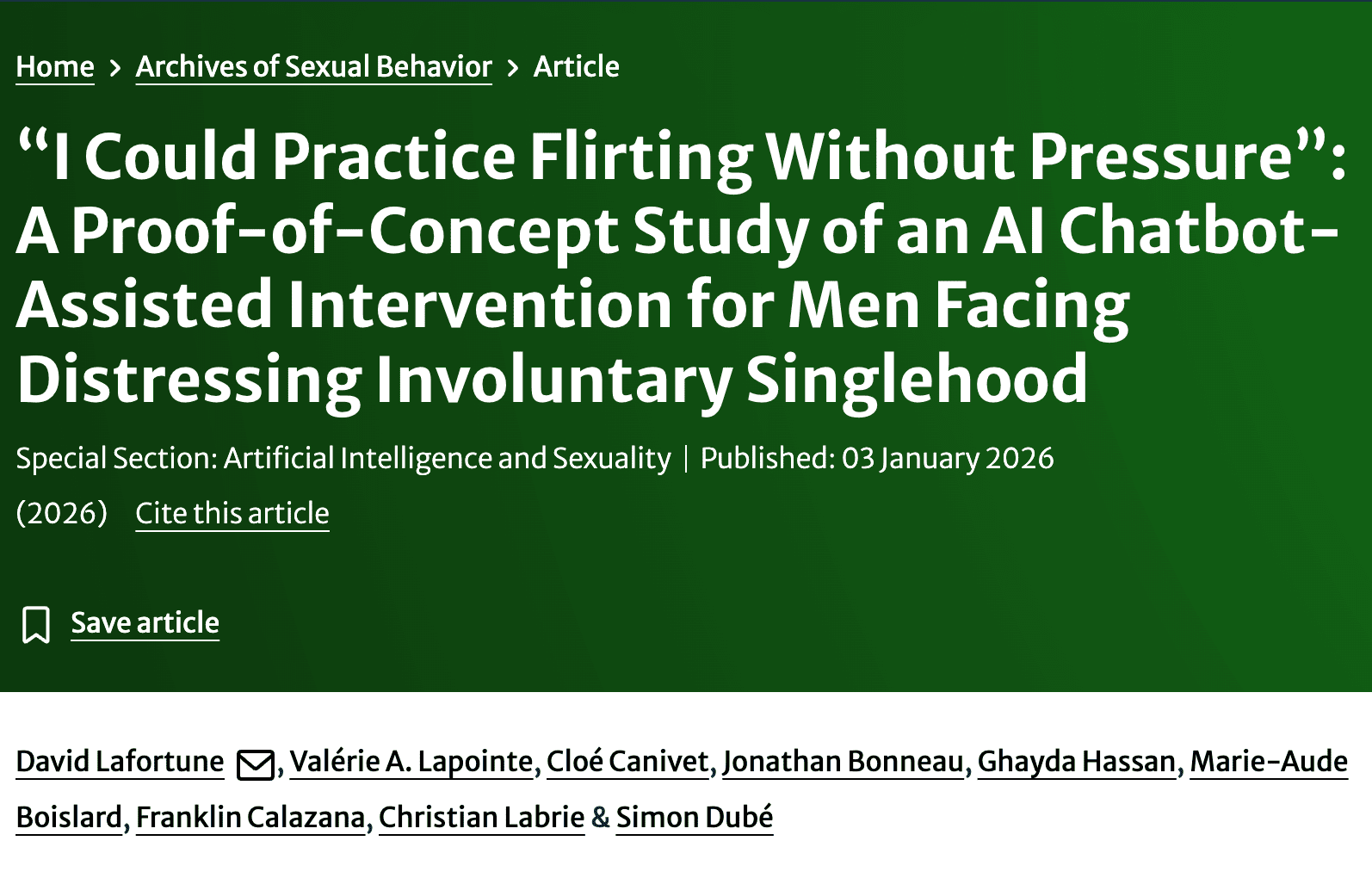
Canadian sexology researchers are hoping to make further versions of a fake dating app called Kindling, that showed positive wellbeing results when used by a group of men described as “chronically single”.
Researchers at the University of Quebec in Montreal created the fake AI dating platform for a study of 32 single men. When using Kindling, each participant messaged with an AI character called Marie, who was programmed to encourage them to open up to her, before she rejected them as a potential date.
Tough love can be a good thing, it seems. The men reported drops in loneliness and general decreases in mental stress after using Kindling and meeting the charming but unobtainable Marie. This despite the inevitable AI rejection they got in the experiment, and despite the men knowing that Marie wasn’t a real person.
Researchers said that considering the results, Kindling could prove useful when approaching ways to tackle male loneliness and dating confidence, and perhaps offer an intervention point for isolated men at risk of sliding toward more toxic online communities.
The full research report is in the Archives of Sexual Behavior, but it’s worth noting that the study involved 32 men described as ‘chronically single’, not a clinical sample of radicalized individuals. This is a long way from a statistically robust basis for sweeping claims about deradicalization, but it remains a potentially interesting proof-of-concept for AI-mediated social skills interventions.
Dating safety concerns? Tap that app map
More dating app research news from Canada comes in the form of a new ‘safety map’ created by a team led by the University of Waterloo.
You can use the dating app safety map to check out the safety-related features of 30 apps, by clicking on their logos on the map. There’s a comparison tool on which you can compare specific dating apps in terms of their safety features.
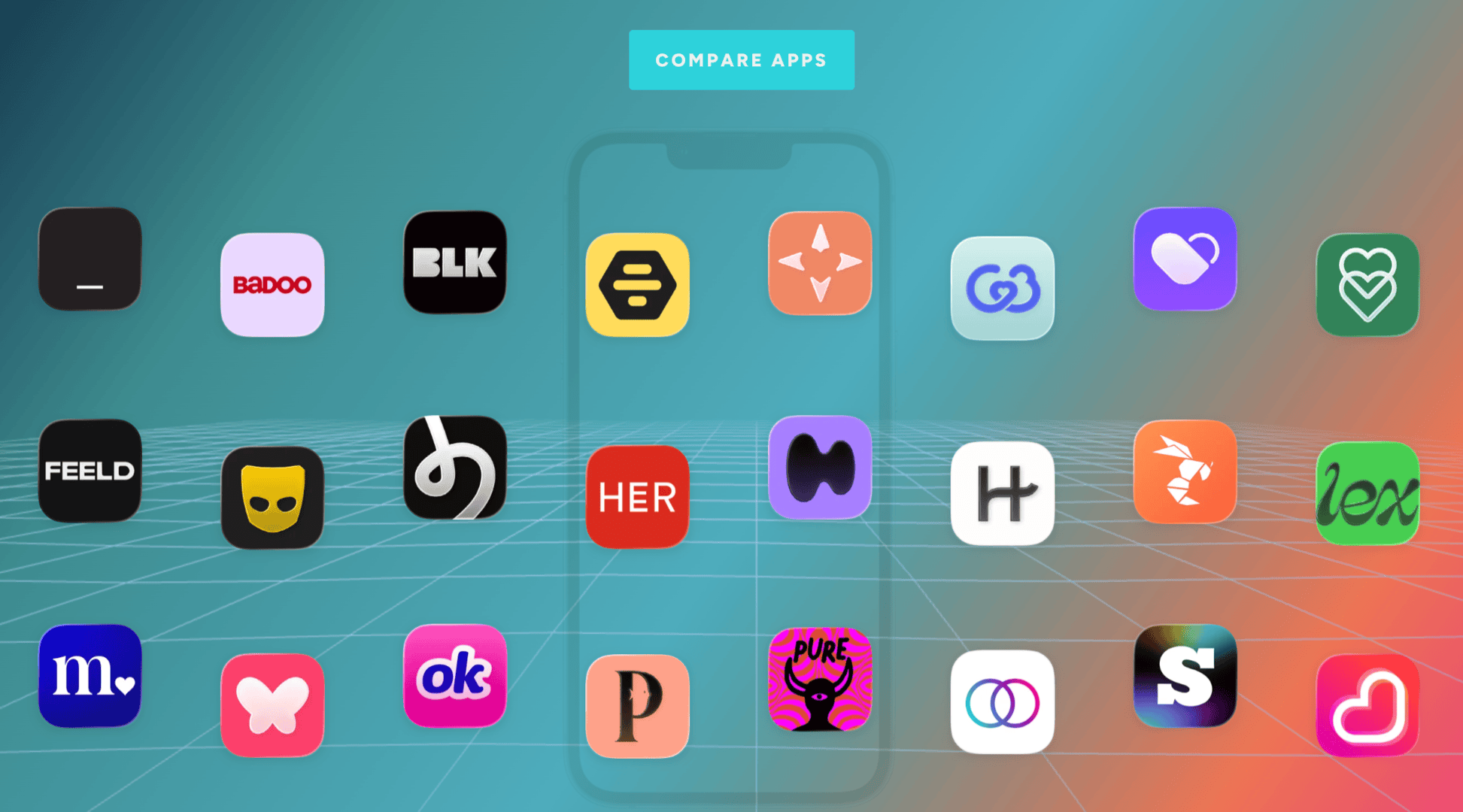
The map was created after analysing the safety policies and features of the various apps, and by interviewing 48 Canadian dating app users for further information.
It’s a simple run-down of safety features, but it’s easy to navigate, so is a handy way to check out features such as disappearing messages and reporting bad app behavior without having to do your own in-depth research of apps you’re considering using.
Diana Parry, a professor in the university’s Faculty of Health, was the lead researcher of the project.
She said: “We were struck by how normalized unsafe or uncomfortable experiences had become and by the amount of unpaid emotional labour users, particularly women, require to stay safe. Many participants described this as exhausting and unsustainable, which helps explain growing swipe fatigue and disengagement from dating apps.”
The map is live at the Coder research site.
Bring on Bumble 2.0
Bumble’s attempt to stop the rot of decreasing total revenue and paying user counts with a relaunch is coming to a head, with ‘Bumble 2.0’ expected to launch soon.
Returning CEO Whitney Wolfe Herd, who came back to the company earlier this year after Bumble’s revenue and paying user counts slid, has given a glimpse of what Bumble 2.0 might be, and it seems the defining function could end up being an in-app AI assistant called Bee.
Bee will operate within a Bumble dating experience called Dates, and will act as a personal dating assistant as well as a matchmaker. Bumble told Mashable that users will chat with Bee about their lifestyle, dating intentions and preferences, which the AI can use to search for highly-compatible potential matches.
Dates is set to launch in beta soon, and Bumble is reportedly building a new cloud-native stack to support what it’s positioning as a ground-up reimagination of the app. Whether AI-heavy features can actually reverse declining user counts is a question the industry hasn’t answered convincingly yet. Hinge’s founder bailing earlier this year didn’t exactly inspire confidence that the first-wave apps have found their footing.
Tinder goes all-in on face scanning
Speaking of OG dating apps, Tinder has moved to shore up scam resistance by introducing compulsory face scans for new app signups in the UK, having already rolled this out across the US in 2025. Compulsory face scans for new users are also in effect in countries and regions including Southeast Asia, Latin America, the Middle East, India, Canada and Australia.
To complete the face scan you use the app to take a video selfie, which is then compared to your profile picture for verification.
Many dating apps have been compelled to crack down on unverified spam and scam accounts recently, and more face scanning should in theory mean less chance for bad actors to create app accounts for nefarious purposes.
It comes at a time when face scanning is becoming more common for online verification generally, with various countries introducing tougher age verification laws for adult content. Whether users should feel comfortable handing biometric data to a company whose track record on user data is, to put it generously, uneven is a reasonable question.
Hinge may join the face scan party soon, with the app reportedly considering introducing compulsory scans.
OKCupid gets its knuckles rapped on privacy
Concerns that compulsory face scans for dating apps may present privacy concerns were hardly allayed recently when OKCupid had its knuckles (wings?) rapped for sharing users’ images with a third-party company.
Match Group, which owns the dating app, agreed to settle a US Federal Trade Commission lawsuit that claimed that in 2014 Match Group gave Clarifai, a facial recognition tech company, access to user information including over three million photos. The FTC said this was against OKCupid’s own private policies, and that users were never told that their information would be shared, reported Reuters.
The settlement carries no financial penalty for now, which is a notably soft outcome for a company that was ordered to pay $60M to Tinder users just months ago. If Match Group makes similar violations in future, civil fines become possible, but the FTC’s track record of meaningful deterrence against large platforms isn’t exactly inspiring. For its part, Match Group says it has shored up its privacy practices since the incident in 2014.
Another little reminder that not everything you submit to your dating app may stay between you, your matches, and any friendly AI ‘dating assistant’ lurking around.



















Leave a Reply