

We kick off dating app news in 2026 with the return of sorts of the controversial Tea ‘man vetting’ app, which is likely to be welcomed and feared in equal measure.
Elsewhere Grindr’s super special plans to launch multiple businesses flogging products to customers through the app have been glimpsed at, a new app that requires you to chat to an AI chatbot for ages has launched, and Japanese corporations are encouraging employees to use a specific dating app so they don’t quit their jobs after having children.
All this and more in our monthly news roundup. Here’s to another glorious year in the dating app world.
Tea app is back on web browser
A new web browser version of the controversial Tea ‘date-vetting’ app, that was removed from Apple’s App Store in October over privacy, moderation and user experience standards, has launched.
Tea became hugely popular in 2025, and was used by women to share information about men they may be dating or have matched with on dating apps. These ‘reviews’ were unverified and concerns were raised about privacy and potential defamation.
The app faced multiple lawsuits and although it was removed from the Apple App Store, it remained on Google Play.
Now a new web version, available at app.teaforwomen.com, has launched. It operates in the same way as the original app, offering iPhone users another way to access it.

Jessica Dees, Tea’s head of trust and safety, told Fast Company: “Launching our web experience is a strategic move toward platform resilience, allowing us to establish a scalable hub that isn’t dependent on a single distribution channel.”
Dees added: “Tea helps women review patterns and potential red flags rather than relying on isolated claims. By enabling women to exchange real-world insight in a moderated environment, [Tea] helps create earlier awareness, reduce risk, and support safer decision-making, which can be life-saving in a dating landscape where many forms of harm escalate precisely because warning signs are missed or shared too late.”
Despite the controversies, including concerns about user privacy as well as the privacy of the men featured, Tea remains massively popular and many women welcomed the web launch.
Japanese corporations care deeply about employees’ love lives
In Japan there’s a growing trend for corporations taking control of their employees’ love liv… sorry, we mean, kindly helping their employees find love through dating apps.
An app called Aill goen that connects employees who work for approved corporations launched in 2021 and has recently gained traction, with over 1,500 Japanese companies including Toyota signed up.

The app only connects the employees of companies that offer things like established childcare systems and policies to promote women’s participation in the workplace. The hope is that it leads to the formation of couples in which both partners have similar, strong family care provisions from their employer, so they’ll be less likely to leave their jobs after they have children.
Toyota said: “At our company, we believe that finding a partner who suits you leads to greater fulfilment in your private life, and that fulfilment can have a positive impact on work… based on this thinking, we expect Aill goen to provide a safe and high-quality place for meaningful connections.”
Partiful becomes a dating app
The popular event-planning app Partiful has become a dating app of sorts.
The app recently launched a function called Crush, that allows you to select a contact in the app to be your crush. The ‘crush’ gets a notification about the last event the pair of you both attended, but the ‘crusher’s’ identity is not revealed unless the ‘crushee’ also selects the ‘crusher’ as a ‘crush’.
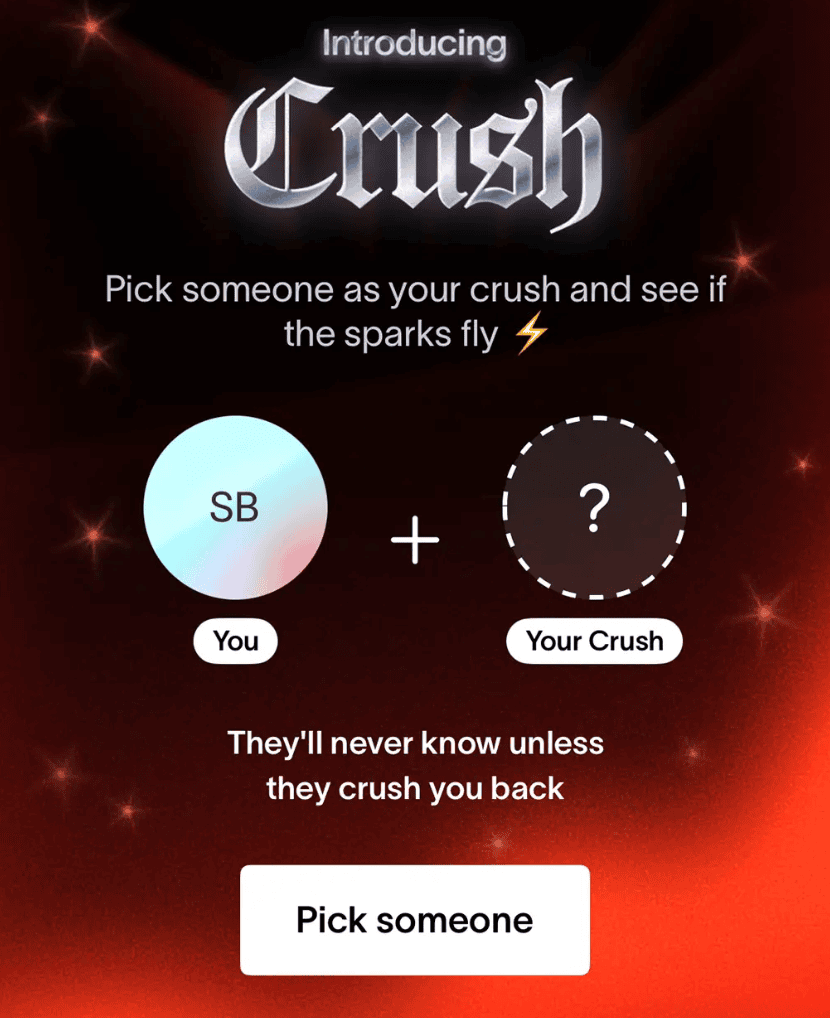
If that happens you get a prompt to chat to each other in the app, and you’re away. You’re limited to ten ‘crushes’ per month.
Shreya Murthy, Partiful’s cofounder, told Business Insider: “We built Crush because we know that meeting someone in real life is still something we all want, arguably more than ever. But the problem today is the lack of follow-through: you meet someone at a party, you feel a spark, and then nothing happens because reaching out feels too intimidating or high stakes.”
Grindr does the business
Grindr seemingly wants to sell you more than hookups and in-app podcasts – the world’s biggest LGBTQ+ dating app reportedly plans to launch four direct-to-consumer businesses by 2028.
An internal product strategy document seen by Business Insider outlined the early stages of the plan, following Grindr starting to sell medical products in 2025. The company’s goal is allegedly to have four direct-to-consumer businesses, with each earning up to $30 million in revenue.
Specifics of what these businesses will be haven’t been unearthed, but the internal document gives clues. It reads: “Our users have significant disposable income and are spending it on DTC [direct-to-consumer] products and services elsewhere – e.g., medications; wellness and fitness products; luxury experiences; travel; networking.”
Grindr launched an erectile dysfunction business called Woodwork in 2025, and executives have previously talked about potentially expanding to sell skincare and haircare products.
Recently Grindr has been rolling out a posting function called Right Now, that facilitates users making short-notice meet-ups.
Speak to AI, sort a date
A new dating app that suggests potential matches based on long speaking conversations you have with the app’s AI has launched.
The app, Known Dating, is a San Francisco-based startup. To use it, you have a long speaking conversation with the app’s AI system, so it can get the measure of your interests and tastes. These conversations last an average of 26 minutes, but some have lasted longer than an hour and a half.
Once your natter with the AI is done, it makes its assessments and presents potential matches that you can declare your interest in. You can use the app’s AI assistant to find out more about the potential match, then if you both confirm you’re interested you match and are pushed by the app to confirm a meeting then organize a date.
Known Co-founder Celeste Amadon said: “People self-censor when writing profiles, but they are more authentic when speaking. Many young women don’t want to write ‘looking for an emotionally stable partner’ in their public profiles, but in private conversations, they naturally express it.”
Known is currently operating in beta mode and is expected to fully launch soon. You can join the app’s waitlist on Known’s site.


















Leave a Reply